
Mesa lots, canyon slopes, graded pads
Hydroseeding in San Diego, CA
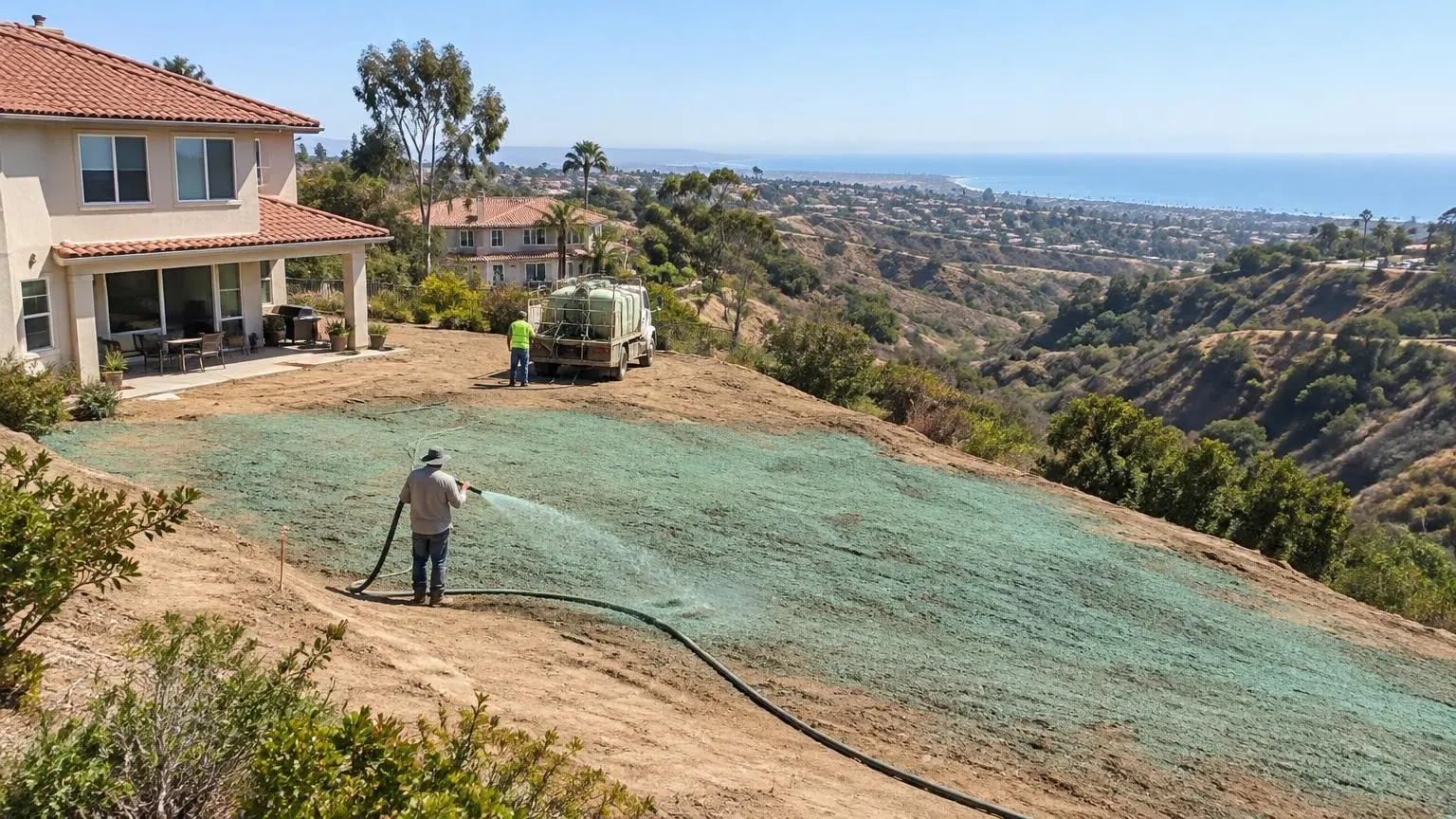
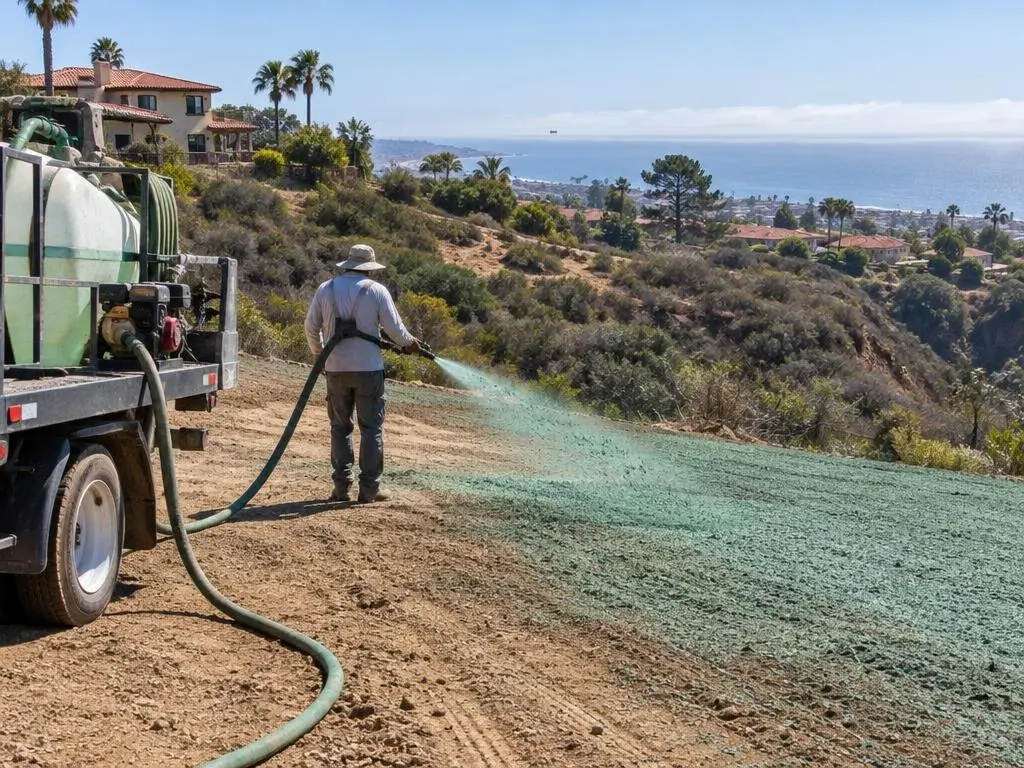
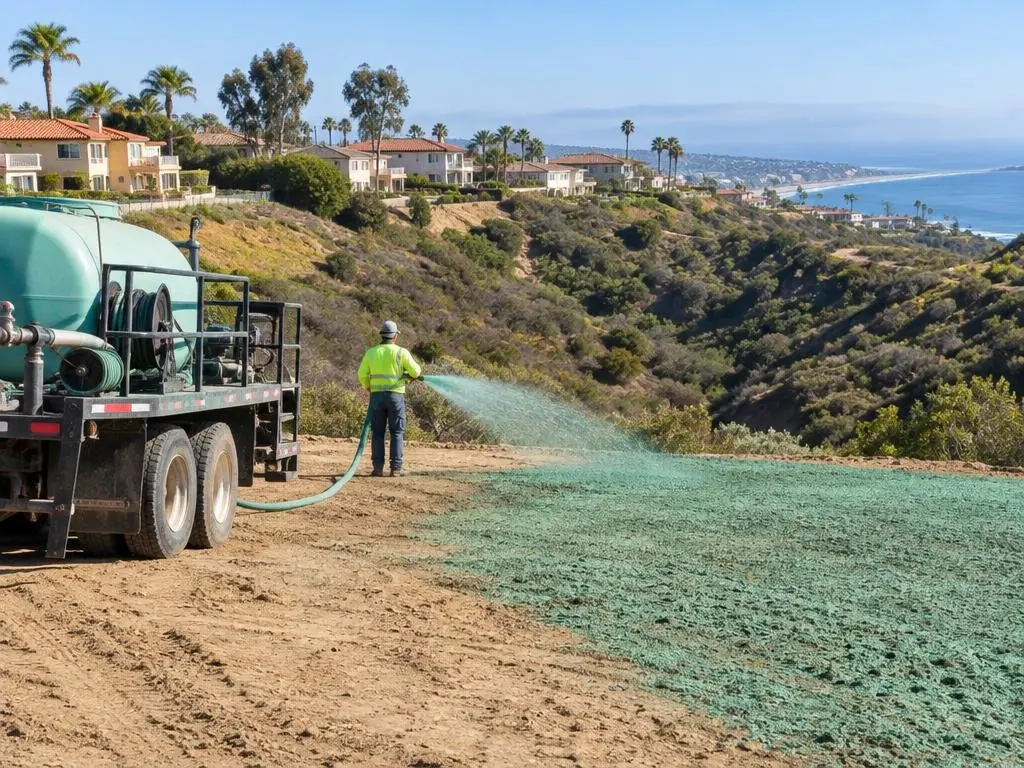
Seed, fiber mulch and tackifier sprayed on prepared ground, planned around a rainy season that lasts about four months.
- No-charge site visit, with your estimate put in writing
- Seed mix matched to coastal or inland conditions
- A written watering plan with every new lawn
Grass and Ground Cover for a Dry, Canyon-Cut City
Hydroseeding in San Diego works when it is timed to the rain and matched to the ground underneath. The tank mix is water, wood fiber mulch, seed, a tackifier and fertilizer, sprayed over prepared soil, and the mulch holds moisture against the seed while it sprouts. That matters in a city where the airport averages under 10 inches of rain a year and nearly all of it lands between December and March. Whether the job is a new lawn on a mesa-top lot in Clairemont, cover for the slope behind a Tierrasanta home, or stabilization on a freshly graded pad, the method stays the same. What changes is the seed mix, how heavy the mulch goes on, and the calendar.
Mesas, canyons and where the water goes
San Diego sits on mesas separated by roughly 200 deep canyons and hills. People built on the flat tops and mostly left the canyons wild, so a huge number of backyards end at a rim. The San Diego River cuts across the middle of the city from east to west, and reservoirs and Mission Trails Regional Park break up the developed areas further. For seeding, this means two things. First, a lot of lawns sit just uphill from a slope, and every gallon of roof and patio runoff that crosses the yard ends up on that slope. Second, the slope itself is often too steep or too dry for turf. We plan both together: lawn on the flat part, a heavier erosion treatment or native mix on the face, and drainage that sends water where it can soak in instead of cutting a gully over the edge.
Rain that comes all at once
The 1991 to 2020 normals at San Diego International Airport add up to 9.79 inches a year. February averages 2.20 inches and January 1.98, while June averages 0.05 and August just 0.01. There are only about 40 days a year with measurable rain, and when a storm does arrive it can dump a lot at once. The swings between years are big too: some winters have topped 24 inches, and the driest have brought as little as 3.2. Bare soil in this climate spends months baking and then gets hit by a few heavy storms. That is exactly the situation hydromulch is built for. The fiber and tackifier lock seed to the surface so the first real rain waters it instead of washing it into the street.
Coast, inland and Santa Ana days
The marine layer that gives the coast its May gray and June gloom usually burns off about 5 to 10 miles inland. Downtown averages January lows near 50 and August highs near 78; El Cajon, only 12 miles inland, averages 42 and 88. A lawn in Ocean Beach and a lawn in Rancho Bernardo need different watering, and sometimes different grass. Then there are the Santa Ana winds: strong, extremely dry winds off the interior, best known for autumn heat, often drop relative humidity below 10 percent, and come 10 to 25 times in a typical year, usually lasting about three days. A Santa Ana event can dry new seed in an afternoon. When one is forecast during establishment, we tell you to add short watering cycles until it passes.
Soils: terrace clay and decomposed granite
Two very different soils cover a lot of the county. On old alluvial fans and marine terraces near the coast, series like Huerhuero have a brown loam surface over a dense clay subsoil with very slow water movement. Water ponds, then runs off, and graded fill on top of that clay gets hard as a sidewalk. Farther inland, soils like the Vista series formed from decomposed granite on hills with slopes from gentle to very steep: coarse sandy loam that drains fast and erodes easily once the surface is disturbed. On clay we rip compacted ground, add topsoil where it is thin, and recommend shorter, more frequent irrigation cycles. On granite we lean on heavier mulch and tackifier and slow the water down on slopes.
Sod vs hydroseed vs dry seed
Sod gives you a finished look the day it goes down, and it is the only practical way to get St. Augustinegrass, which UC's lawn guide lists as planted from sod or stolons, not seed. It also costs the most. HomeGuide's figures make the gap plain: hydroseeding comes in between 12 and 35 cents per square foot, against $1 to $4 for laid sod. Dry broadcast seed is the cheapest, but the seed sits exposed, birds and wind take some, and University of Nebraska Extension notes it typically takes two to three weeks to show, compared with 5 to 7 days for hydroseed. In San Diego's dry air, the mulch blanket is the difference. Hydro seeding costs a bit more than dry lawn seeding and much less than sod, and it is the clear choice on slopes, where sod rolls are hard to pin and dry seed simply washes off.
Choosing grass and the seeding window
UC's turf guide lists six species as best adapted to most California conditions. Tall fescue is a cool-season grass with moderate to high heat tolerance and is the usual pick for an all-year green lawn here. Bermudagrass is warm-season, takes heat and drought well and handles hard wear, so it suits full-sun inland yards and play areas. Kentucky bluegrass, perennial ryegrass and red fescue have low heat tolerance on their own and do better in blends near the coast. For tall fescue, our favorite window is fall: September stays nearly as warm as August at the airport, but by late October and November days cool off and the winter rains are close behind. Bermudagrass wants warm soil, so late spring into early summer is its window, with irrigation carrying it through the dry months. Native slope mixes go down in fall so winter rain does the work.
Stormwater rules on bigger jobs
California's Construction Stormwater General Permit, Order 2022-0057-DWQ, took effect on September 1, 2023. It covers clearing, grading, stockpiling and excavation on projects that disturb an acre or more, and it can reach a smaller lot too when that lot belongs to a bigger development whose total disturbance hits an acre. Locally, the San Diego Regional Water Quality Control Board issues the municipal storm sewer permit to 39 cities, counties and districts, and the City of San Diego enforces its own stormwater rules and Stormwater Standards Manual under it. In practice, a builder's job site needs sediment kept on the lot and bare ground covered. That is where our silt fence, fiber rolls, inlet protection and hydromulch come in, sized to the plan your engineer or SWPPP writer has drawn up.
Common Questions
How much does hydroseed typically cost in San Diego?
Depending on which national guide you read, residential hydroseeding runs about $0.07 to $0.35 a square foot. HomeGuide's example of a 5,000 square foot lawn comes to $1,000 to $1,750, and it puts the usual minimum job charge at $300 to $500 or more. Slopes, heavy prep and premium seed push the number up. We quote in writing after a free site visit.
What is the best month to hydroseed in San Diego?
For tall fescue and other cool-season mixes, late October and November work well: the heat is easing and the winter rains are close. Bermudagrass wants warm soil, so late spring into early summer is its window. Native slope mixes go down in fall so the rains can germinate them.
Is hydroseeding worth the money?
For most bare yards and nearly all slopes, yes. It costs a fraction of sod, comes up faster than dry seed because the mulch holds moisture, and on a slope it is far more likely to stay put. The trade-off is time: expect the first mowing somewhere between week four and week six, and a few months before the lawn is fully filled in.
Is lawn hydroseeding expensive compared with sod?
No. HomeGuide puts hydroseeding at 12 to 35 cents per square foot ($0.12 to $0.35) and sod at $1 to $4. Sod only wins on price-for-result when you need a usable lawn immediately or want St. Augustinegrass, which is not grown from seed.
Can I hydroseed in summer here?
Yes, as long as the area has working irrigation. From May through September San Diego gets almost no rain, so the lawn will depend completely on sprinklers, often two or three short cycles a day at first. Bermudagrass handles summer seeding best.
Will hydroseed hold on the slope at the back of my yard?
It holds much better than dry seed because the tackifier glues the mulch and seed to the soil. On steep canyon faces we usually step up to a bonded fiber matrix or a rolled blanket, with a silt fence or fiber roll at the bottom, and we often suggest a native mix instead of lawn grass.
How soon can I walk on a new hydroseed lawn?
Stay off the new grass until it has been mowed once, usually four to six weeks out. Seed generally shows in 5 to 14 days depending on the grass and the weather, but the roots are shallow and easy to tear in the first month.
Our Services
Hydroseeding services plus the slope, sediment and grading work around them, for San Diego homes, builders and HOAs.
Hydroseed Lawns
New lawn installation from bare dirt, with soil prep, the right seed for your microclimate and a watering plan.
Learn more →Commercial & Development Hydroseeding
Large-area hydroseeding for builders, HOAs and public projects, sized to the site's stormwater plan.
Learn more →Canyon Slope Erosion Control
Canyon edges, cut slopes and drainage swales covered with hydromulch, BFM or rolled erosion control blankets.
Learn more →Silt Fence & Storm Drain Protection
Silt fence installation, fiber rolls and inlet protection that keep sediment on the lot and out of the storm drains.
Learn more →Dirt Work & Fine Grading
Yard grading, topsoil, drainage trenching and soil prep so seed goes down on ground that drains the right way.
Learn more →Native Canyon & Wildflower Seeding
Native seed mixes for canyon slopes, fire-cleared ground and low-water areas that can live on winter rain.
Learn more →From the South Bay to North County
We work across the City of San Diego and the county around it. In the South Bay that means Chula Vista, National City, Bonita and Imperial Beach, where new subdivisions, river valleys and the driest weather in the region all show up. In East County, El Cajon, La Mesa, Santee, Lakeside and Alpine sit in warmer valleys and foothills, where seed needs more water and slopes run steep. North County inland covers Escondido, San Marcos, Vista, Poway, Ramona and Fallbrook, with decomposed granite hillsides, fire-recovery ground and acreage lots. Along the coast, Oceanside, Carlsbad, Encinitas, Solana Beach, Del Mar and Rancho Santa Fe deal with lagoons, sandstone bluffs and estate grounds. The individual town pages get into the soil, slopes and timing that set each one apart.
- Hydroseeding in San Diego, CA
- Hydroseeding in Chula Vista, CA
- Hydroseeding in Oceanside, CA
- Hydroseeding in Escondido, CA
- Hydroseeding in Carlsbad, CA
- Hydroseeding in El Cajon, CA
- Hydroseeding in Vista, CA
- Hydroseeding in San Marcos, CA
- Hydroseeding in Encinitas, CA
- Hydroseeding in Santee, CA
- Hydroseeding in Poway, CA
- Hydroseeding in La Mesa, CA
- Hydroseeding in Ramona, CA
- Hydroseeding in Alpine, CA
- Hydroseeding in Lakeside, CA
- Hydroseeding in Fallbrook, CA
- Hydroseeding in Bonita, CA
- Hydroseeding in National City, CA
- Hydroseeding in Solana Beach, CA
- Hydroseeding in Del Mar, CA
- Hydroseeding in Rancho Santa Fe, CA
- Hydroseeding in Imperial Beach, CA
Why Homeowners Call Hydroseeding San Diego
Rain-season planning
We schedule seeding so establishment lines up with the December to March rains wherever the job allows, and we tell you plainly when a lawn will run on irrigation alone.
Microclimate seed choices
A yard under the marine layer and a yard in El Cajon do not get the same mix or the same watering plan.
Slopes treated as slopes
Canyon faces get heavier mulch, blankets or a bonded fiber matrix and something at the toe to catch soil, not just more lawn seed.
Prep included in the estimate
Grading, topsoil, ripping compacted fill and erosion control each get their own line on the quote, so no cost is buried inside another.
Have Bare Ground Before the Rains?
Tell us about the lawn, slope or job site and we will set up a free visit and written estimate.